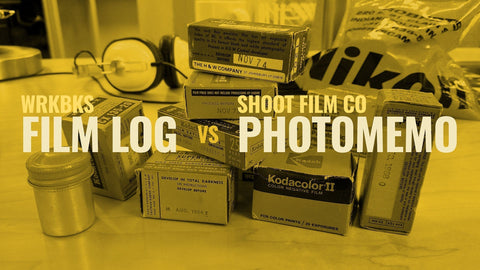
Most film logs are lined notebooks with "Film Photography" printed on the cover. PhotoMemo is one of them. Ours isn't.
We built the WRKBKS Film Photography Log around one idea: every frame is its own decision. Camera, lens, exposure, subject — they can all change shot to shot, even within the same roll. A log that only leaves room for one camera, one lens, and one location per roll isn't logging your process. It's logging a guess.
Here's what that looks like side by side.
Per-Roll vs. Per-Shot
PhotoMemo gives you one field for Lens and one for Location, at the top of the spread. That assumes you shoot a whole roll on one lens, in one place. Plenty of photographers don't.
Our log puts Focal Length and Subject/Location in the per-shot table — 36 numbered rows, one for every frame on a standard 35mm roll. Change lenses mid-roll, move across town between frames — it's all still logged correctly.

The Full Comparison
| Field | WRKBKS Film Photography Log | PhotoMemo |
|---|---|---|
| Camera | Top-left, easy to find | Top of spread, secondary to Roll # |
| Roll # | Pre-printed, upper right | Blank line, write it in |
| Dates | Date Loaded + Date Exposed | Start Date + End Date |
| Film / ISO | Same box, plus a separate Frame Count field | One line for both |
| Format | Checkboxes for Color/B&W, 35mm, 120, or write-in | Not specified |
| Expiration date | Dedicated field | None |
| Lens | Logged per shot | One field per roll |
| Location | Logged per shot | One field per roll |
| Shot log | 36 numbered rows — Subject/Location, Focal Length, F-Stop, Speed, Flash, Tripod | Unlabeled lines, ~34 shots |
| Developing notes | Full B&W and color notes — times, mixtures, Developed On date | Checkboxes for pushed/pulled, stops, processed/scanned/archived |
| Spreads per book | 22 | 23 (sold as a 2-pack) |
Why We Kept It to 22 Spreads
PhotoMemo sells more spreads for the same price. We'd rather give you 22 spreads that actually hold your process than more pages with less on each one. A properly logged roll — camera, per-shot exposure data, full developing notes — takes more room than a place to jot a location once and move on.
Bottom Line
If you shoot a full roll in one place on one lens and just want a record that it happened, a basic notebook works fine. If your rolls move between locations, lenses, and lighting — which is how most film photographers actually shoot — you need a log built for that. That's what we built.