You load the roll, set the ISO, raise the camera. Then someone asks you what film you have in.
You think you know. You're pretty sure it's the Kodak Gold. But it might be the Ultramax you loaded last Tuesday. And there's a third camera in the bag — the one you loaded with HP5 for the indoor stuff — and you can't remember if you already shot half of it or if it's fresh.
This is not a beginner problem. This is a five-cameras-in-rotation problem. A "I shoot more than I process" problem. It's the problem that made me start keeping a film logbook, and it's what eventually led to building one worth carrying.
The film photographer's EDC is a small conversation. It doesn't need to be complicated. But it does need to be intentional — which is kind of the whole point of shooting film in the first place.
Start with the obvious
Your everyday carry when shooting film starts with the camera. That sounds obvious, but it shapes everything else — a point-and-shoot in a jacket pocket has a very different kit than a medium format folder in a shoulder bag. The carry should match the camera.
After that, the non-negotiables:
- An extra roll or two. The moment you leave without one is the moment the light turns perfect at the end of your last frame.
- Fresh batteries if your camera needs them. Carry them sealed, not loose — a battery that's been rattling around discharges faster than you'd think.
- A lens cloth. Small, flat, no excuse not to have one.
Beyond that, most film photographers narrow their kit down to what can either fit in a pocket or clip to a bag without getting in the way. Analog photography is already a deliberate slowdown. The carry should reflect that.
The piece most film shooters skip: a film log
The most common analog photography EDC advice covers cameras, film, filters, maybe a lightmeter. The one thing that rarely makes the list — and that film photographers almost universally wish they'd started earlier — is a film logbook.
Not a notes app. Not a voice memo. A field log you keep with the camera.
Here's why it matters: film photography has a delay built in. You shoot today, you develop in two weeks, you scan in three. By the time you're looking at an image, the context of how it was made is gone — ISO, aperture, shutter speed, whether you were metering for the shadows or the highlights, what lens you had on, what the light was actually doing. Without a 35mm film log, you can't learn from the roll. You're just looking at results with no path back to the decision.
With one, every roll becomes a lesson.
Tracking your film also solves the rotation problem. If you're running multiple cameras simultaneously — and a lot of analog photographers are — a film stock tracker is the only way to know what's loaded where without opening the back. Which camera has the pushed HP5. Which one has the fresh Portra. Which one you loaded in the field in low light and aren't entirely sure about.
What to log
The goal of a film photography log isn't exhaustive documentation — it's capturing what you'll actually want to know later. For most 35mm and 120 film shooters, that's:
- Camera and lens
- Film stock, ISO (including push/pull)
- Date and location
- Lighting conditions and metering approach
- Frame-by-frame exposure notes (or at least the ones that felt uncertain)
- Developing instructions — especially for pushed film or anything non-standard
The developing notes field is the one most people forget until they hand off a roll and realize they can't remember what they told the lab they wanted. Getting that right closes the loop on the whole process.
The pen question
A logbook without a pen is just paper. The carry answer here is a field pen — something compact, durable, and reliable in the conditions you're actually shooting in. Cold weather, damp hands, low light. Something that writes the first time without a warmup drag across the page.
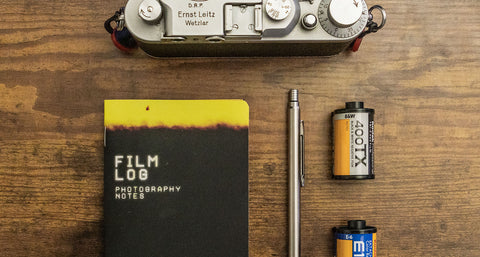
Brass bolt-action pens have become a standard in analog EDC for a reason: they're weighted, they clip securely, and they write on demand. Keep one with the logbook. Treat them as a set.
The carry that makes it stick
The film photography EDC only works if it actually comes with you. That means the logbook needs to be the right size — small enough to not be an argument every time you pack the bag, but structured enough to be useful in the field.
The WRKBKS Film Photography Log is built around that constraint: 3.5″ × 5.5″, purpose-built for 35mm and 120 film, with structured spreads for per-frame exposure logging, developing notes, and the field details you'll actually want later. Designed in Indiana, printed in the USA. Fits in a shirt pocket or camera bag side pouch without taking up real estate.
It exists because nothing else was built specifically for this. The alternatives were general memo books dressed up with photography branding — which isn't the same thing.
Keep it simple
The film photographer's EDC doesn't need to be a gear list. It needs to be a system: camera, film, field log, pen. Everything else is optional. The carry that works is the one you don't have to think about — the one that's already there when the light changes and you need to move fast.
Start logging. Even rough notes are better than nothing. After a few rolls, you won't shoot without it.
🐦